Regulations -
Forest Practices Code of BC Act TIMBER
HARVESTING AND SILVICULTURE PRACTICES REGULATION B.C.
Reg. 352/2002 Part 1 – Definitions and Interpretation Definitions and interpretation 1 (1) Unless
otherwise indicated, words and expressions not defined in this regulation
have the meaning given to them in section 1 of the Operational and Site
Planning Regulation. (2) In this regulation: “applicable performance standard” means the specific level to which a person must
perform a requirement of sections 16, 30, 31 or 32 on an area, (a) if
the area is subject to a silviculture prescription, as specified in the
silviculture prescription, or (b) if
the area is not subject to a silviculture prescription, as specified for the
area in a forest development plan; “direct tributary” means the reaches of a tributary stream that have
the same stream order as the most downstream reach of the tributary; “fisheries-sensitive zone” means a flooded depression, pond or swamp, that (a) either perennially or seasonally contains
water, and (b) is seasonally occupied by a species of fish
listed in the definition of “fish stream” in the Operational and Site
Planning Regulation, but does not include a wetland or lake that has a
riparian management area established under Part 8 of the Operational and Site
Planning Regulation or a stream; “harvesting” means the practice of felling trees, felling and
removing trees, or the removal of dead or damaged trees from an area; “known”, when used to describe a feature, objective or
other thing referred to in this regulation as known, means a feature,
objective or other thing that is (a) identified in an operational plan that
applies to the area, as a known objective, feature or thing, or (b) if there is no operational plan, (i) contained in a higher level plan, or (ii) otherwise identified or made available to a
person by the district manager, before the exemption of the operational plan or the preparation
of a site plan; “landing” means an area of land that has been modified by
equipment to make it suitable for accumulating logs before they are
transported; “silviculture treatment” means a treatment carried out individually or as
part of a regime of treatments to create the described post harvest stand
structure, site conditions or free growing stand conditions; “sidecast” means the act of moving excavated material onto the
downslope side of an excavated or bladed trail, or a landing, during their
construction. (3) If there
is a conflict between the Workers
Compensation Act or a regulation made under that Act and this regulation,
the Workers Compensation Act or the
regulation made under that Act prevails. (4) References in this regulation to the
district manager include references to a designated forest official
authorized by the district manager unless the context indicates otherwise. Part 2 – Variances and Authorizations Authority
of the district manager to vary a performance requirement 2 (1) A holder of an agreement under the Forest Act may submit to the district manager a request for a
variance under this section. (2) A request
for a variance must specify all of the following: (a) the
area for which the variance is requested; (b) the
requirement of this regulation to which the variance relates; (c) the
proposed performance requirement; (d) a
rationale for making the request. (3) On
application by a holder under subsection (1), or with the consent of the
holder, the district manager may grant a variance, only if satisfied that
implementing the variance (a) will
adequately manage and conserve the forest resources on the area affected by
the application, or (b) is
in the public interest. (4) The
district manager may not grant a variance to (a) an
applicable performance standard that is contained in a forest development
plan or a silviculture prescription, or (b) a requirement under section 38 (2) (a), (c)
or (d). (5) The
district manager may grant a variance subject to conditions. (6) If the
district manager rejects an application for a variance, the district manager
must provide to the applicant a written rationale for the rejection. Compliance
with notices, authorizations, conditions and variances 3 (1) A holder of an agreement under the Forest Act must comply with any notice, authorization, condition
or variance made or granted by the district manager to the holder under this
regulation. (2) A
variance or authorization made or granted under this regulation is not
affected by a subsequent amendment to a forest development plan, unless the
amendment specifically provides that it supersedes the variance or
authorization. Part 3 - Timber Harvesting and
Related Forest Practices Division
1 – General Constraints Harvesting within community watersheds 4 (1) Subsections (2) and (3) apply to an area
only if (a) a terrain stability field assessment is required
to be carried out for the forest development plan or silviculture
prescription that applies to the area, or (b) the area has been exempted from the
requirement for a forest development plan or silviculture prescription, and a
terrain stability field assessment is required to be carried out as a
condition of the exemption. (2) A holder of an agreement under the Forest Act must not harvest an area
that is within a community watershed if the result of the terrain stability
field assessment indicates that the area is subject to a high likelihood of
landslides. (3) A holder of an agreement under the Forest Act must not clearcut an area
that is within a community watershed if the result of the terrain stability
field assessment indicates that the area is subject to a moderate likelihood
of landslides with a high risk of landslide debris entering directly into
streams, unless (a) the terrain stability field assessment
documents the assessor’s opinion that, based on the assessment, the assessor
has reasonable grounds to believe that clearcutting the area will not
significantly increase the risk of a landslide, or (b) the use of a clearcut silvicultural system
has been approved in a forest development plan or a silviculture prescription
for the cutblock. (4) A holder of an agreement under the Forest Act who is carrying out
harvesting in a community watershed must not, except to provide access to, or
to maintain, a community water supply intake, cut or damage a tree that is
closer than 100 m upslope of a known community water supply intake. (5) A holder of an agreement under the Forest Act who is carrying out
harvesting in a community watershed must protect known community water supply
intakes and infrastructures. (6) A holder of an agreement under the Forest Act who is carrying out
harvesting in a community watershed must not cause the quality of water to
fail to meet known water quality objectives. Harvesting on potentially unstable terrain 5 (1) Subsection (2) applies to an area only if (a) a terrain stability field assessment is
required to be carried out for the forest development plan or silviculture
prescription that applies to the area, or (b) the area has been exempted from the
requirement for a forest development plan or silviculture prescription, and a
terrain stability field assessment is required to be carried out as a
condition of the exemption. (2) A holder of an agreement under the Forest Act must not clearcut an area
that is outside a community watershed if the result of the terrain stability
field assessment indicates that the area is subject to a high likelihood of
landslides, unless (a) the terrain stability field assessment
documents the assessor’s opinion that, based on the assessment, the assessor
has reasonable grounds to believe that clearcutting the area will not
significantly increase the risk of a landslide and that there is a low
likelihood of landslide debris (i) entering into a fish stream or a perennial
stream that is a direct tributary to a fish stream, or (ii) causing damage to private property or public
utilities, including but not limited to roads, bridges, transmission lines,
pipelines, recreation sites or any other similar structures, or (b) the use of a clearcut silvicultural system
has been approved in a forest development plan or silviculture prescription
for the cutblock. (3) A holder of an agreement under the Forest Act who is carrying out
harvesting must not sidecast material onto slopes that have a high likelihood
of landslides. Harvesting adjacent to previously harvested
cutblocks 6 (1) A holder of an agreement under the Forest Act may harvest a cutblock that is adjacent to a
previously harvested cutblock only if that previously harvested cutblock is
greened-up. (2) Despite subsection (1), a holder of an
agreement under the Forest Act may
harvest a cutblock that is adjacent to a previously harvested cutblock that
is not greened-up, if the requirements in any of the following paragraphs are
met: (a) the cutblock to be harvested is under a
licence to cut or Christmas tree permit, or the previously harvested cutblock
was harvested under a licence to cut or Christmas tree permit; (b) a partial cut silvicultural system is used
that retains trees in a uniform distribution throughout the cutblock to be
harvested, and 40% or more of the preharvest basal area will be retained; (c) a partial cut silvicultural system is used
that retains less than 40% of the preharvest basal area throughout the
cutblock to be harvested, and (i) before commencement of harvesting the
district manager has authorized, in writing, retention of less than 40% of
the preharvest basal area, and (ii) after completion of harvesting, either the
retained trees are uniformly distributed throughout the cutblock or the cutblock
is stocked with trees, and the average height of those trees that are the
tallest tree in each 0.01 hectare plot included in a representative sample is
at least 3 m, and the trees are a commercially valuable species or other
species acceptable to the district manager; (d) the total area of (i) the cutblock to be harvested, and (ii) the harvested cutblocks that are not
greened-up and that are adjacent to the cutblock to be harvested do not exceed the maximum size for cutblocks specified or varied
under section 11 of the Operational and Site Planning Regulation; (e) the harvesting of the cutblock is necessary
to achieve established visual quality objectives and the harvesting has been
approved in an operational plan; (f) the resultant opening has been authorized by
the district manager, in a written notice given to the person, on the grounds
that it will be consistent with the structural characteristics and the
temporal and spatial distribution of natural openings; (g) the proposed harvesting will recover timber
that was damaged by fire, insects, wind or other similar events and, wherever
possible, the cutblock to be harvested incorporates structural
characteristics of natural disturbance. Marking wildlife trees and wildlife tree patches 7 (a) 0.25 hectare or more, unless exempted by the
district manager, or (b) less than 0.25 hectare, if required by the
district manager. (3) A holder of an agreement under the Forest Act who is required to mark a
wildlife tree or wildlife tree patch under subsection (1) must ensure
that the marking is visible during harvesting and will remain visible for at
least 6 months after the completion of harvesting. Division
2 - Protection of Streams and Riparian Areas Harvesting adjacent to unidentified or incorrectly
classified 8 (1) A holder of an agreement under the Forest Act must not harvest or modify trees in a riparian reserve
zone of a stream, wetland or lake if the stream, wetland or lake has not been
identified, or has been given an incorrect riparian classification, in an
operational plan, except in accordance with section 9 (1), based on the
correct classification. (2) For the purposes of subsection (1), a
stream, wetland or lake is not shown with an incorrect riparian
classification in an operational plan by reason only that the law that
applied to the plan at the time it was approved or given effect is
subsequently changed, unless an enactment specifically provides otherwise. (3) A holder of an agreement under the Forest Act who is harvesting in a
riparian management area for a stream, wetland or lake that has not been
identified, or that has been given an incorrect riparian classification, in
an operational plan, must harvest in a manner that is consistent with the
general objectives for riparian management zones for the correct riparian
class of the stream, wetland or lake, including the range of basal area
retention, specified in a forest development plan that includes the area. Felling
or modification of trees in a riparian reserve zone 9 (1) A
holder of an agreement under the Forest
Act must not fell or modify trees in a riparian reserve zone unless the
felling or modification has been (a) undertaking
recreational facility management; (b) reducing
windthrow potential by topping or pruning; (d) creating
corridors for full suspension yarding; (e) removing
trees for the construction or modification of a road under an approved road
layout and design; (f) removing
any tree that is hazardous to workers because of location or lean, physical
damage, overhead hazards, deterioration of limbs, stems or root system or a
combination of these; (g) carrying
out sanitation treatments; (h) recovering
trees that have been windthrown or have been damaged by fire, insects,
disease or other causes; (i) managing
fisheries values or wildlife values; (j) carrying
out any other similar activity. (2) Despite
subsection (1), the holder of a licence to cut or of a free use permit must
not fell or modify trees in a riparian reserve zone unless the harvesting or
modification is approved for purposes related to the holder’s right to use or
occupy Crown land granted under the Land
Act, Coal Act, Geothermal Resources Act, Mines Act, Mineral Tenure Act,
Mining Right of Way Act, Petroleum and Natural Gas Act or Pipeline Act. Constraining
slash and debris in and around aquatic environments 10 A holder of an agreement under the Forest Act who carries out harvesting
or a silviculture treatment must not deposit a volume of slash or debris,
capable of damaging fish habitat or reducing water quality, into any of the
following: (a) a lake; (b) a wetland; (c) a fisheries-sensitive zone or a
marine-sensitive zone; (d) a fish stream; (e) a stream in a community watershed; (f) a stream with a known licensed domestic
water supply intake downstream of the area being treated; (g) a stream that (i) can transport the slash and debris into any
of the areas listed in paragraphs (a) to (f), or (ii) may be destabilized by the accumulated slash
and debris, resulting in increased sediment deposition in the areas listed in
paragraphs (a) to (f). Restricted operation of machinery 11 (1) A
holder of an agreement under the Forest
Act who carries out harvesting or a silviculture treatment must not
permit tracks or wheels of ground based machinery within 5 m of a stream
bank except in the following cases: (a) for carrying out fire fighting activities; (b) in response to natural disasters; (d) if operations will be conducted in a manner
that protects stream banks and minimizes damage to understory vegetation. (2) The district manager may exempt a holder of
an agreement under the Forest Act
from the requirements of subsection (1) if (a) the machinery is operated (i) to construct or maintain a range development
or utility, (ii) to construct or maintain a work or to carry
out an activity within or adjacent to streams for the purpose of controlling soil
erosion, protecting stream banks or managing fisheries or wildlife, or (iii) for an activity similar to one described in
subparagraphs (i) and (ii), or (b) in the opinion of the district manager, (i) no other practicable option exists for
carrying out the harvesting or silviculture treatment, or (ii) operating the machinery more than 5 m
from the stream bank will increase the risk of sediment delivery. (3) A holder of an agreement under the Forest Act who carries out harvesting
or a silviculture treatment must not fuel or service machinery in a riparian
management area of a stream or wetland or within 30 m of a lakeshore. (4) Subsection (3) does not apply on an approved
landing or road, or to machinery that is any of the following: (a) hand held; (b) required for fire fighting; (c) broken down and requires fuelling or
servicing to be moved; (d) authorized in a silviculture prescription to
be fuelled or serviced in the area. Yarding, skidding and log drop areas 12 (1) A
holder of an agreement under the Forest
Act who is carrying out harvesting must not yard or skid timber through
or over any fisheries-sensitive zone. (2) A holder of an agreement under the Forest Act who is carrying out
helicopter, balloon or another type of aerial harvesting must not use as a
log drop area (a) the littoral zone of a marine or fresh water
system, (b) water that is less than 10 m deep, or (c) a marine-sensitive zone. Maintaining stream bank stability 13 A holder of an agreement under the Forest Act who is carrying out
harvesting or stream cleaning, for purposes other than constructing or
modifying 14 (1) A
holder of an agreement under the Forest
Act (a) protects the stream channel and stream bank
immediately above and below the stream crossing, and (b) mitigates disturbance to the stream channel
and stream bank at the crossing. (2) Without limiting subsection (1), the holder
of an agreement under the Forest Act
must carry out construction, repair or removal of a temporary stream crossing
and other operations in a fish stream in accordance with timing windows or
measures required to adequately manage and conserve aquatic resources
provided in writing by a designated environment official. (4) Despite subsection (3), if an approved road
layout and design applies to the temporary stream crossing the removal must
be in accordance with that road layout and design and with any approved
deactivation measures. 15 (1) A
holder of an agreement under the Forest
Act who harvests timber in a riparian management zone for a S4, S5 or S6
stream must retain a sufficient
number of those streamside trees whose crowns provide the shade to the stream
that is required to prevent the stream temperature from increasing if the
stream is a direct tributary to a S1, S2, S3 or S4 stream that is a known temperature sensitive stream. (2) A holder of an agreement under the Forest Act who harvests timber adjacent to a S4, S5 or S6 stream
that (a) is a direct tributary to a S1, S2 or S3
stream or to a marine-sensitive zone, and (b) has trees that provide, or contribute
significantly to the maintenance of, stream bank or channel stability, or
both, must retain, standing adjacent to the stream, the
number and distribution of the trees referred to in paragraph (b) that is
sufficient to maintain the stream bank or channel stability, or both, as the
case may be. Division
3 - Protection of Non-Timber Resources 16 (1) A
holder of an agreement under the Forest
Act must ensure that the total area, in or adjacent to cutblocks, that is
occupied by wildlife trees is (a) at
least the total area specified in the applicable performance standard for the
retention of wildlife trees, or (b) if
there is no applicable performance standard, for each calendar year, at least
the proportion of the cutblock area required as wildlife tree retention
specified in chapter 3.2 of the 1999 Ministry of Forests and the Ministry of
Environment, Lands and Parks publication “Landscape Unit Planning Guide”. (2) A holder
of an agreement under the Forest Act
must ensure that the total amount of coarse woody debris located on cutblocks
in which harvesting is complete is at least the total amount for cutblocks
specified in the applicable performance standard, if any, for retention of
coarse woody debris. Protection
of resource features 17 The prescribed circumstances for the
purposes of section 51 (2) of the Act are that (a) the
holder of an agreement under the Forest
Act who is carrying out the forest practice is the holder of a site plan
required under section 21.1 of the Act, (b) the
resource feature is identified in the site plan, and (c) the
holder carries out forest practices on the area in a manner that does not
threaten the resource features referred to in paragraph (b). 18 A holder of an agreement under the Forest Act who carries out harvesting
or a silviculture treatment in a known wildlife habitat area must carry it
out in accordance with known general wildlife measures that are (a) established for application within the
wildlife habitat area, and (b) made available to the person by the
designated environment official at the time the wildlife habitat area is made
known. Minor salvage operations in specified areas 19 A holder of an agreement under the Forest Act must not carry out a minor
salvage operation in any of the following areas, unless harvesting the area
has been approved in a silviculture prescription or the person has received,
in writing, from the district manager, the terms and conditions that apply to
the carrying out of the minor salvage operation: (a) riparian management zones; (b) known forest ecosystem networks; (c) wildlife tree patches; (d) known old growth management areas; (e) known ungulate winter ranges. Harvesting in old growth management areas 20 A holder of an agreement under the Forest Act who is carrying out
harvesting in a known old growth management area must not clearcut in the
area unless (a) clearcutting the area has been approved in a
forest development plan, or (b) if there is no forest development plan that
includes the area, clearcutting the area has been authorized in writing by
the district manager, with or without conditions. Division
4 - Access Structures Temporary landings, borrow pits or gravel pits under
a site plan (2) A holder of an agreement under the Forest Act who
constructs a temporary landing referred to in subsection (1) must ensure
that the landing conforms with section 21. 21 A holder of an agreement under the Forest Act who is constructing a
landing must (a) construct it at least 30 m from a fish
stream or a stream in a community watershed, unless (i) there is no other practicable location for
the landing, (ii) constructing the landing closer to the
stream will not create a high risk of sediment delivery to the stream, and (iii) the district manager approves constructing
the landing less than 30 m distance from the stream, and (b) incorporate drainage systems to minimize
runoff flowing onto the landing and erosion of the landing fill and material. Deactivating landings that are permanent access
structures 22 (1) A
holder of an agreement under the Forest
Act must deactivate a landing that is a permanent access structure when
the landing is no longer required to facilitate harvesting operations. (2) A holder of an agreement under the Forest Act who is deactivating a landing must (a) incorporate drainage systems to minimize
runoff flowing onto the landing and erosion of the landing fill and material,
and (b) carry out measures to ensure that the
landing is stable. Rehabilitating a temporary road or landing (a) constructs
or modifies a road, or (b) constructs
a landing that is a
temporary access structure for the purposes of carrying out a forest practice
on an area, must rehabilitate the road or landing, as the case may be, (d) when
specified in an operational plan for the area, or (e) if
not specified in the operational plan, as soon as is practicable after the
structure is no longer required for the forest practice. (2) A holder of an agreement under the Forest Act who is rehabilitating a
road on an area under subsection (1), must (a) carry out the applicable measures specified
in an operational plan for the area, or (b) if no applicable measures are specified in
the operational plan, do all of the following: (i) decompact the road, including removing woody
debris that is conducting or is likely to conduct subsurface moisture; (ii) place fill material that was sidecast on the
excavated portion of the road; (iii) re-establish natural surface drainage; (iv) place some woody debris over exposed mineral
soil; (v) revegetate exposed mineral soil. (3) A holder of an agreement under the Forest Act who is rehabilitating a
landing on an area under subsection (1) must (a) carry out the applicable measures specified
in an operational plan for the area, or (b) if no applicable measures are specified in
the operational plan, do all of the following: (i) incorporate drainage systems to minimize
runoff flowing onto the landing and erosion of the landing fill and material; (ii) carry out measures to ensure that the
landing area is stable; (iii) decompact the landing area, including
removing woody debris that is conducting or is likely to conduct subsurface
moisture; (iv) spread retrievable soil material, that was
displaced to construct the landing, over the surface of the landing; (v) re-establish natural surface drainage; (vi) place some woody debris over exposed mineral
soil; (vii) revegetate exposed mineral soil. (4) The district manager may exempt a person who
is required to rehabilitate a road or landing under this section if the district
manager is satisfied that the rehabilitation is not necessary to ensure that
the forest resources on the area will be adequately managed and conserved. (5) Without limiting subsection(4), a person who
is required to rehabilitate a road or landing under this section is exempted
if the person specified in an operational plan for the area that the road or
landing would not be rehabilitated. Rehabilitating a temporary borrow pit or gravel pit (2) A holder of an agreement under the Forest Act who, on an area that is
under a site plan, constructs a borrow pit or gravel pit that is a temporary
access structure, is exempted from the requirements of section 47 (6.1)
of the Act to rehabilitate the borrow pit or gravel pit. (3) The district manager may, by written notice,
require a person who is exempted under subsection (1) or (2) to rehabilitate
a borrow pit or gravel pit if the district manager is satisfied that the
rehabilitation is necessary to ensure that the forest resources on the area
will be adequately managed and conserved. (4) A person who receives a notice referred to
in subsection (3), must comply with the requirements specified in the
notice. Rehabilitating a corduroyed trail or compacted area (a) a silviculture prescription, or (b) a site plan constructs
a corduroyed trail or creates a compacted area, is exempted from the
requirements of section 47 (7) of the Act to rehabilitate the
corduroyed trail or compacted area. (2) The district manager may, in writing,
require a person who is exempted under subsection (1) to rehabilitate a
corduroyed trail or a compacted area if the district manager is satisfied
that the rehabilitation is necessary to ensure that the forest resources on
the area will be adequately managed and conserved. (3) A person who receives a notice referred to
in subsection (2), must comply with the requirements specified in the
notice. Landing and roadside debris accumulations 24 (1) A
holder of an agreement under the Forest
Act who is carrying out a harvesting operation must (a) deposit debris that accumulates from the
construction and use of landings in the area of the landing or in other areas
that are approved by the district manager, and (2) Subject to subsection (3), if the holder of
an agreement under the Forest Act
burns the debris referred to in subsection (1) (b) the holder must burn it in
the first burning season after harvesting is completed or, if it is
insect-infested, before the insects emerge. (3) If the district manager determines that
burning cannot take place as required under subsection (2) because the debris
is too wet to burn or environmental conditions prevent burning, the district
manager may authorize, in writing, a different period of time for completion
of the disposal of the debris. (4) If the method for disposing of debris accumulations
resulting from roadside harvesting operations requires piling of the debris,
the holder of an agreement under the Forest
Act who is carrying out the piling operation must not operate
ground-based equipment on the area adjacent to the road during periods when
the soil strength is not sufficient to prevent the wheels or tracks of the
equipment, used to carry out the piling, from creating concentrated soil
disturbance if it is apparent that continuing the piling operations will
result in the total amount of soil disturbance within this area being greater
than the amount specified in section 32. Excavated
and bladed trails may be constructed 25 Subject to sections 26 to 29, a holder
of a site plan required under section 21.1 of the Act may construct an
excavated or bladed trail on the area under the site plan. Limitations on where an excavated and bladed trail
may be constructed 26 (1) Subsections
(2) and (3) apply to an area only if (a) a terrain stability field assessment is
required to be carried out for the forest development plan or silviculture
prescription that applies to the area, or (b) the area has been exempted from the
requirement for a forest development plan or silviculture prescription, and a
terrain stability field assessment is required to be carried out as a
condition of the exemption. (2) A holder of an agreement under the Forest Act must not construct an
excavated or bladed trail on an area that is outside a community watershed if
the result of the terrain stability field assessment indicates that the area
is subject to a high likelihood of landslides. (3) A holder of an agreement under the Forest Act must not construct an
excavated or bladed trail on an area that is outside a community watershed if
the result of the terrain stability field assessment indicates that the area
is subject to a moderate likelihood of landslides, unless the assessment
documents the assessor’s opinion that, based on the assessment, the assessor
has reasonable grounds to believe that (a) the excavated or bladed trail can be
located, constructed and rehabilitated in a manner that will not
significantly increase the risk of landslides, and (b) there is a low likelihood of landslide
debris (i) entering into a perennial stream in a
community watershed, a fish stream or a perennial stream that is a direct
tributary to a fish stream, or (ii) causing damage to private property or public
utilities, including but not limited to roads, bridges, transmission lines,
pipelines, recreation sites, or any other similar structures. (4) Without restricting subsection (3), a holder
of an agreement under the Forest Act
must not construct an excavated or bladed trail on an area that is within a
community watershed if (a) the soil erosion hazard and risk of sediment
delivery to streams have not been assessed, or (b) the results of the soil erosion hazard
assessment and risk of sediment delivery to streams assessment indicate that (i) the site has a (A) high or very high soil erosion hazard, and (B) moderate, high or very high risk of sediment delivery to streams,
or (ii) the site has a moderate or high likelihood of landslides. (5) Subsection (4) does not apply if the trail
construction is approved for the purpose of (a) constructing
access required to carry out activities on tenures issued under the Coal Act or Mineral Tenure Act, or (b) carrying
out activities authorized under the Mines
Act, Mining Right of Way Act, Petroleum and Natural Gas Act or Pipeline Act. Requirements when constructing excavated or bladed
trails 27 A holder of an agreement under the Forest Act who is constructing an
excavated or bladed trail must comply with all the following requirements: (a) must not deposit (i) soil material that has been excavated to construct the trail, or (ii) slash in a stream,
wetland, lake or fisheries-sensitive zone, or in a position where the
material can be transported by water into any of these watercourses; (b) must not create cutslopes and fillslopes
that are subject to slumping and continual raveling; (c) must maintain surface drainage patterns; (d) must prevent subsurface seepage water,
intercepted by the trails, from being diverted into areas that would not
naturally have received the water, and that are (i) slopes that are unstable or potentially
unstable or subject to a moderate or high likelihood of landslides, or (ii) stream channels or gullies; (e) must do the requirements in paragraphs (a)
to (d) in a way that minimizes soil erosion and the amount of sediment
entering streams; (f) must do
the requirements in paragraphs (a) to (d) in a way that facilitates
carrying out required rehabilitation treatments. Requirement to rehabilitate excavated or bladed
trails 28 (1) Before
December 15, 1999, for the purposes of section 47 (7) of the Act, a holder of
an agreement under the Forest Act
who constructs or modifies an excavated or bladed trail within an area under
an operational plan must rehabilitate the area occupied by the trail in
accordance with section 29, if the trail is located on an area that (a) has a moderate or high likelihood of
landslides, a high or very high soil erosion hazard, or is an area where the
soil erosion hazard has not been determined, or (b) is within a community watershed. (2) If timber harvesting commences on or after
December 15, 1999, a holder of an agreement under the Forest Act who constructs or modifies an excavated or bladed
trail must rehabilitate the area occupied by the trail in accordance with
section 29. (3) A holder of an agreement under the Forest Act is exempt from any
requirement under section 68 of the Act to carry out rehabilitation of an
excavated or bladed trail in accordance with a silviculture prescription or
logging plan, if the trail meets both of the following conditions: (a) it is constructed or modified before
December 15, 1999; (b) it is not located on an area referred to in
subsection (1). Requirements when rehabilitating excavated or bladed
trails 29 Unless otherwise approved in an
operational plan, a holder of an agreement under the Forest Act who is rehabilitating an excavated or bladed trail
must do all of the following: (a) decompact the trail, including removing
woody debris that is conducting subsurface moisture; (b) place fill material that was sidecast on the
excavated portion of the trail; (c) recontour the slope; (d) re-establish natural surface drainage; (e) place some woody debris over exposed mineral
soil; (f) revegetate exposed mineral soil. Division
5 - Soil Conservation Limits
on the amount of permanent access structures 30 (1) At the end of timber harvesting operations
in a cutblock, a holder of an agreement under the Forest Act must not cause the proportion of the cutblock area
occupied by permanent access structures to exceed (a) the
applicable performance standard, or (b) if
there is no applicable performance standard, 7% of the area within the
cutblock, including any reserves within the cutblock. (2) Unless
exempted by the district manager, a holder of an agreement under the Forest Act, at the conclusion of using
a permanent access structure, other than a road, that was constructed by the
holder, must deactivate the permanent access structure. (a) the
size, topography and engineering constraints of the cutblock cannot
accommodate the required permanent access structures, (b) the
additional permanent access structures are necessary to ensure the safety of
those persons who are (i) using the permanent access structures, or (ii) carrying out forest practices on the area, or (c) the
additional permanent access structures are necessary to provide access beyond
the cutblock. (4) A holder
of an agreement under the Forest Act
referred to in subsection (3) must amend the operational plan or site plan
for the area to record (a) the
revised proportion of the cutblock that is occupied by permanent access
structures, and (b) the
rationale for the revised proportion. Limits
on the amount of soil disturbance 31 (1) In this section, “sensitive soils” means soils on an area that through a
combination of climate, soil properties, site moisture conditions and site
topography have (a) in
the Interior, a very high soil compaction hazard, soil displacement hazard or
soil erosion hazard, and (b) on
the Coast, a high or very high soil compaction hazard, soil displacement
hazard or soil erosion hazard. (2) A holder
of an agreement under the Forest Act
must not cause the soil disturbance on the net area to be reforested within a
standards unit to exceed (a) the
applicable performance standard, or (b) if
there is no applicable performance standard, (i) 5% of the area in the standards unit if the area has sensitive
soils, and (ii) 10% of the area in the standards unit if the area does not have
sensitive soils. (3) Despite
subsection (2), a holder of an agreement under the Forest Act may exceed the soil disturbance limits under that
subsection if (a) the
harvesting on the area was to remove infected stumps, or (b) specific
site rehabilitation or site preparation objectives for the area are contained
in the forest development plan. (4) Despite
subsection (2), a holder of an agreement under the Forest Act may temporarily exceed the soil disturbance limits
referred to in that subsection if (a) the
extra disturbance (i) is for the construction of temporary access structures or
excavated or bladed trails, and (ii) does not exceed 5% of the standards unit, and (b) the
holder rehabilitates the area to the extent necessary to bring the area back
into compliance with the specified limits. Maximum allowable soil disturbance for roadside work
areas 32 A holder of an agreement under the Forest Act who carries out roadside
harvesting operations, including decking, processing, loading and any
associated debris disposal or piling operations, in an area that is (a) within
the net area to be reforested, and (b) used
to carry out those activities, must not cause the
amount of soil disturbance to exceed (c) the
proportion that is specified in the applicable performance standard, or (d) if
there is no applicable performance standard, 25% of the area. Rehabilitation of disturbed areas 33 (1) A
holder of an agreement under the Forest
Act who is required to rehabilitate a disturbed portion of an area under
section 46 (4) or 47 (5) or (7) of the Act must (a) restore the disturbed portion of the area to
a productive state, (b) reduce surface soil erosion in the area, and (c) reasonably mitigate the impact of the forest
practice that made the rehabilitation necessary on forest resources that are
identified (i) in higher level plans or operational plans,
or (ii) by the district manager, if the forest
practice was exempted from the requirement of a logging plan or silviculture
prescription or site plan. (2) For the
purposes of section 49 (2) (d) of the Act, the district manager may exempt a
person who is the holder of a site plan from the requirement to rehabilitate
areas under section 46 (4) or 47 (5) to (7) of the Act if the district
manager is satisfied that treating the area is unlikely to restore soil
productivity on the area to a level acceptable to the district manager. 34 In this Part “person required to establish a free growing stand” means (a) a
holder of an agreement under the Forest
Act who is required to establish a free growing stand under section 69.1
(3) or 70 (3) of the Act, and (b) the
district manager where the government is required to establish a free growing
stand under section 69.1 (2) or 70 (2) of the Act. Requirements for areas under a site plan 35 (1) For
the purposes of section 69.1 (4) (c) of the Act, the prescribed stocking
standards that the person required to establish a free growing stand on an
area under a site plan must meet, by the regeneration date, and after that
date maintain, are the stocking requirements specified for the area in the
forest development plan. (2) For the
purposes of section 69.1 (4) (d) of the Act, the prescribed stocking
standards that the person required to establish a free growing stand on an
area under a site plan must establish, by the free growing date, are the
stocking requirements specified for the area in the forest development plan. (3) Despite
the expiry of a forest development plan, if before the expiry of the plan the
government or the holder of the plan is required to establish a free growing
stand on a cutblock in that plan, the government or the holder, as the case
may be, must establish the free growing stand in accordance with the
information referred to in section 18.1 (2) of the Operational and Site
Planning Regulation as if the forest development plan had not expired. Areas
under a site plan without regeneration objectives 36 (1) The government is exempt from the
requirements of section 69.1 (2) of the Act to establish a free growing stand
on an area under a site plan if the harvesting is limited to (a) commercial
thinning, (b) harvesting
of poles, (c) sanitation
treatments, or (d) intermediate
cuttings, other than those referred to in paragraphs (a) to (c), that do not
have regeneration objectives. (2) The
holder of an agreement under the Forest
Act is exempt from the requirements of section 69.1 (3) of the Act to
establish a free growing stand on an area under a site plan if the harvesting
is limited to (a) commercial
thinning, (b) harvesting
of poles, (c) sanitation
treatments, or (d) intermediate
cuttings, other than those referred to in paragraphs (a) to (c), that do not have
regeneration objectives. (3) For areas
referred to in subsection (1), the government must ensure that, at the
completion of harvesting on the area, the specifications referred to in
section 18.2 of the Operational and Site Planning Regulation are met. (4) For areas
referred to in subsection (2), the holder of the site plan must ensure that,
at the completion of harvesting on the area, the specifications referred to
in section 18.2 of the Operational and Site Planning Regulation are met. (5) Despite the
expiry of a forest development plan, if before the expiry of the plan (a) the
government under subsection (3), or (b) the
holder of the plan under subsection (4) is required to
meet the specifications referred to in section 18.2 of the Operational and
Site Planning Regulation, the government or the holder, as the case may be,
must continue to meet those requirements as if the forest development plan
had not expired. Areas under a silviculture prescription without
regeneration objectives 37 (1) A
holder of a silviculture prescription is exempt from the requirements of
section 70 (4) (d) of the Act if the timber harvesting on the area under the
silviculture prescription is limited to (a) commercial
thinning, (b) harvesting
of poles, (c) sanitation
treatments, or (d) intermediate
cuttings, other than those referred to in paragraphs (a) to (c), that do not
have regeneration objectives. (2) A holder
of an agreement under the Forest Act
who is exempted under subsection (1) must ensure that, at the completion of
harvesting on the area, the applicable stocking requirements referred to in
section 39 (3) (o) of the Operational and Site Planning Regulation are met. Use
of seed and vegetative material 38 (1) In
this section: “seedlot” means a quantity of cones or seeds having the same
species, source, quality and year of collection; “source” means (a) the geographic source of cones, seeds and
vegetative material including the latitude, longitude and elevation of the
source, or (b) the name and licence number of the seed
orchard, cutting orchard or production facility; “vegetative lot” means a quantity of vegetative material or
vegetative propagules having the same species, source and year of collection; “vegetative material” means plant parts or tissues used to produce
vegetative propagules through asexual means; “vegetative propagule” means a plant that has been produced through asexual
means. (2) A person required to establish a free
growing stand under section 69.1 or 70 of the Act who plants trees must (a) use only seedlots or vegetative lots
collected and registered in accordance with the Tree Cone, Seed and
Vegetative Material Regulation, (b) unless otherwise authorized by the district
manager, use the best genetic quality source available, (c) store any tree seeds with the ministry, and (d) keep a record of the registration numbers of
the seedlots or vegetative lots used and the locations where they are
planted. (3) Without limiting subsection (2), if a person
required to establish a free growing stand knows or should know of forest
health factors that affect the health of the species of trees that are
required by the operational plan, the person must use only naturally or
genetically improved resistant seed sources, seedlings or vegetative
propagules if they are available. (4) Without limiting subsection (2) or (3), a
person required to establish a free growing stand must not exceed the limits
for seed or vegetative material transfer specified in the Ministry of Forests
publication, “Seed and Vegetative Material Guidebook”, as amended from time
to time. Use of livestock for site preparation or brush
control 39 A person required to establish a free
growing stand under section 69.1 or 70 of the Act who uses livestock for site
preparation or brush control, must (a) ensure that all necessary measures are taken
to (i) protect fish, wildlife and their habitat, (ii) minimize conflict between livestock and
animals that could prey on livestock, (iii) protect irrigation and licensed domestic
water supply intakes, (iv) prevent transmission of disease from
livestock to wildlife, and (v) maintain the health of livestock, (b) establish a buffer zone on the area if
required to do so by a designated environment official and prevent livestock
from entering the zone, (c) not construct a livestock corral (i) within a riparian management area, or (ii) on a site that drains directly into a
stream, lake or other watercourse bearing fish or used as a potable water
source, (d) notify a designated environment official
before the arrival of the livestock, (e) use only livestock that have been inspected
and certified as required by the Minister of Agriculture, Food and Fisheries,
and (f) not use livestock within a community
watershed to carry out site preparation or brush control within a riparian
management area. 40 (1) A
person required to establish a free growing stand under section 69.1 of the
Act must ensure that all silviculture treatments are designed and carried out
to be consistent with the target stocking standards specified for the area in
the forest development plan. (2) A person
required to establish a free growing stand under section 70 of the Act must
ensure that all silviculture treatments are designed and carried out to be
consistent with the target stocking standards specified for the area in the
silviculture prescription. Spacing
mandatory if maximum density exceeded 41 (1) A person who is required to establish a free
growing stand under section 69.1 or 70 of the Act where the number of
coniferous trees per hectare on the area exceeds (a) 10
000, or (b) a
number specified by the regional manager under subsection (3), must carry out a
spacing treatment on the area before the free growing date to reduce the
number of coniferous trees per hectare to within the maximum and minimum
numbers on the area (c) specified
in the silviculture prescription, or (d) if
there is no silviculture prescription, specified in the forest development
plan. (2) A person required to establish a free
growing stand on an area where (a) the
silviculture prescription for the area was approved before
April 1, 1994, and (b) the
density of lodgepole pine or drybelt Douglas-fir trees per hectare on the
area exceeds (i) 10 000, or (ii) a number specified by the regional manager under subsection (3), must carry out a
spacing treatment on the area to reduce the number of trees to within the
range limited by the maximum and minimum numbers for the area (c) specified
in the silviculture prescription, or (d) if
not specified in the silviculture prescription, specified in writing by the
district manager. (3) For the purposes of subsections (1) and (2),
the regional manager may specify a number other than 10 000. (4) When specifying a number under subsection (3), the regional
manager (a) may specify different numbers for different
areas and species, and (b) must give written notice of the
specification to a person before that person is bound by the specification. (5) The chief forester may (a) establish, vary or cancel policies,
standards and guidelines respecting (i) the regional manager’s specification of a
number of trees per hectare other than 10 000, under subsection (3), (ii) the characteristics of trees that must be
counted for the purpose of determining the number of trees per hectare, and (iii) any other matters related to stand density
management, and (b) make different policies, standards and
guidelines for different areas and species. (6) For the
purposes of determining the number of trees per hectare under this section,
the following coniferous trees must be counted: (a) a
tree that is at least (i) 50% of the median height of the preferred and acceptable well
spaced trees in the survey plot, if the median height is 2 m or greater, or (ii) 30% of the median height of the preferred and acceptable well
spaced trees in the survey plot, if the median height is less than 2 m; (b) if
the silvicultural system is single tree selection, a tree that is at least
1.3 m in height and less than 7.5 cm in diameter measured at a height of 1.3
m; (c) a
tree that meets the criteria established by the chief forester under
subsection (5). Pruning required before the end of the free growing 42 (1) A holder of an agreement under the Forest Act who is required to
establish a free growing stand on an area where the stocking requirements (a) are
intended to achieve wildlife habitat objectives, and (b) are
at least 30% lower than the minimum stocking requirements specified for the
applicable biogeoclimatic zone as set out in the Ministry of Forests
publication “Establishment to Free Growing Guidebook” as amended from time to
time must, before the
free growing date, prune all of the crop trees on the area and ensure that
each crop tree retains at least 30% live crown. (2) The
district manager may relieve a holder of an agreement under the Forest Act from the requirements of
subsection (1) if the district manager determines that wood quality or other
objectives are not compromised by the low stocking levels. 43 (1) A
(a) holder
of an agreement under the Forest Act
who carries out a silviculture treatment and uses fertilizer, and (b) person
who carries out a purpose referred to in section 96 (1) (f.1) of the Act, must store, handle
and apply the fertilizer in a manner that protects forest resources. (2) A holder of an agreement under the Forest Act who carries out a
silviculture treatment and who applies fertilizer other than on spot areas in
a community watershed must not (a) apply fertilizer (i) closer than 100 m upslope of a water
intake, or (ii) within 10 m of a perennial stream that
is observable from the air, at the height the fertilizer will be applied,
unless otherwise authorized by both the district manager and the Minister of
Health or a person authorized by that minister, and (b) cause (i) nitrate nitrogen levels in a stream to
exceed 10 ppm measured immediately below the area where the fertilizer is
applied, (ii) chlorophyll levels to exceed (A) 2 micrograms/litre in a lake, or (B) 50 milligrams/square metre in a stream, or (iii) water quality to fall below any known water
quality objectives. Insect
behaviour modifying treatments 44 (1) A
holder of an agreement under the Forest
Act who uses trap trees or pheromones to concentrate insect populations
must ensure that the insect brood is destroyed before the insects emerge
unless an alternate method of controlling the insect population is provided
in an operational plan. (2) The district manager may exempt a holder of
an agreement under the Forest Act
from complying with subsection (1), with or without conditions, if the
district manager is satisfied that doing so will adequately manage and
conserve forest resources. (3) A holder of an agreement under the Forest Act who is exempted under
subsection (2) must comply with any condition imposed under that subsection. Reporting requirements for areas without
regeneration objectives 45 A holder of an agreement under the Forest Act who has not been exempted
from the requirement to prepare a site plan on an area and who carries out
timber harvesting on the area where (a) there
are partial cutting stocking requirements that do not require regeneration,
or (b) the
harvesting is limited to commercial thinning, harvesting of poles, sanitation
treatments and other intermediate cuttings that do not have regeneration
objectives, must submit to the
district manager (c) on or
before May 31 each year, for areas harvested in the preceding year ending
March 31 and not yet reported, a report providing the information required in
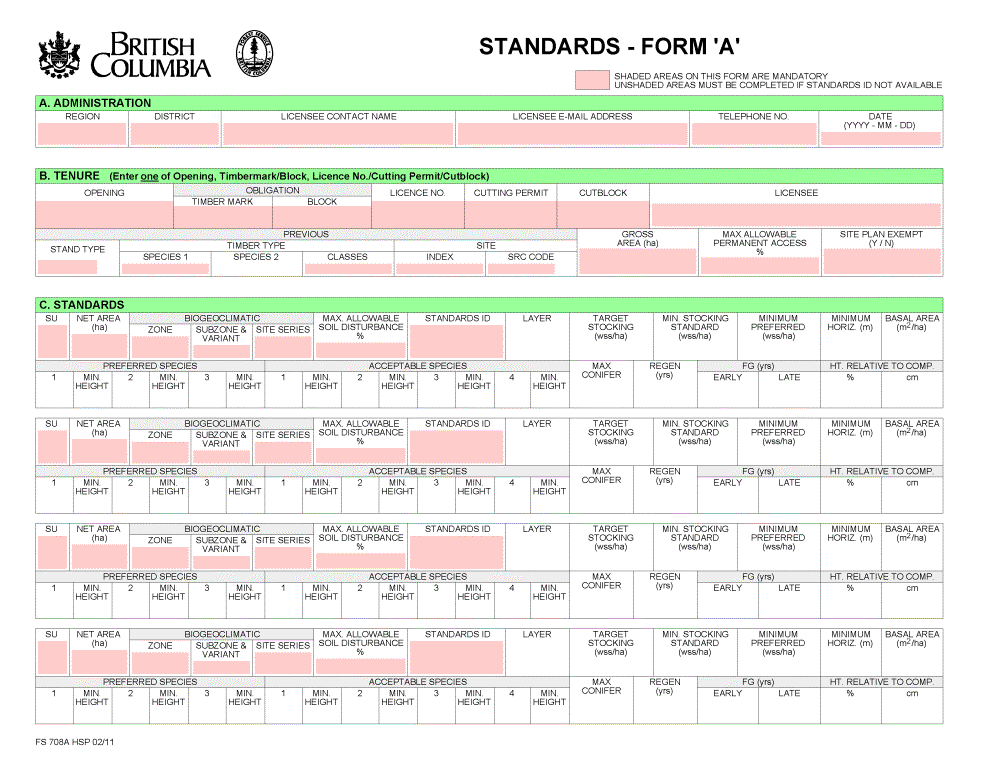
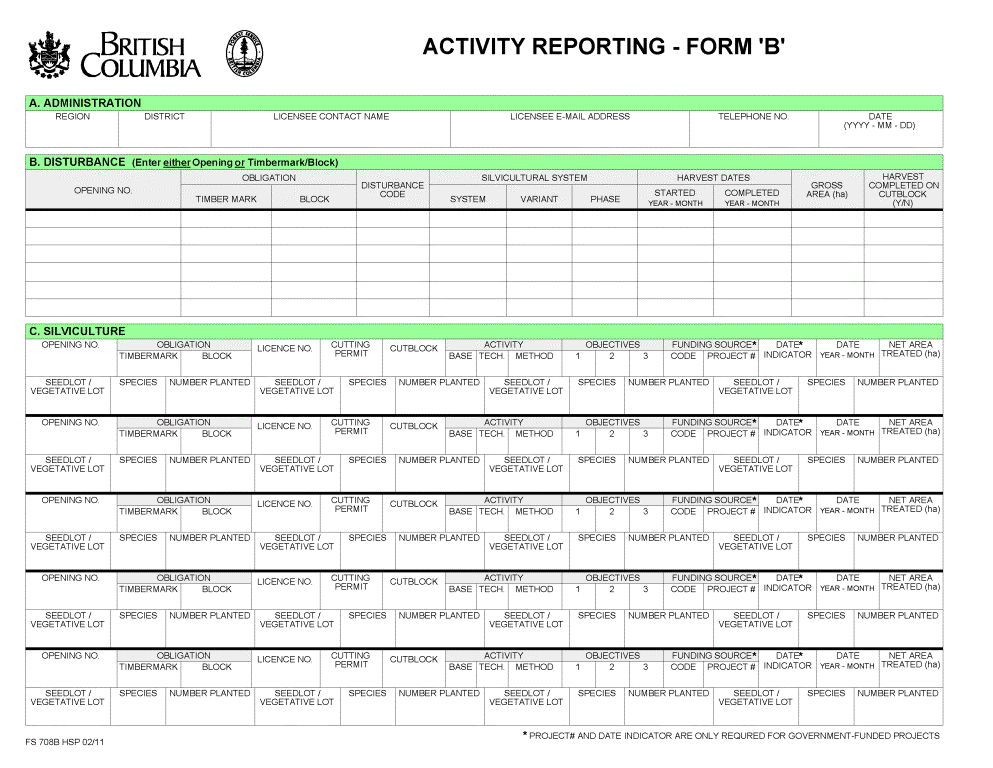
Forms A and B, and a map identifying the standards units on the area, and (d) during
the period between 12 months and 24 months after the completion of harvesting
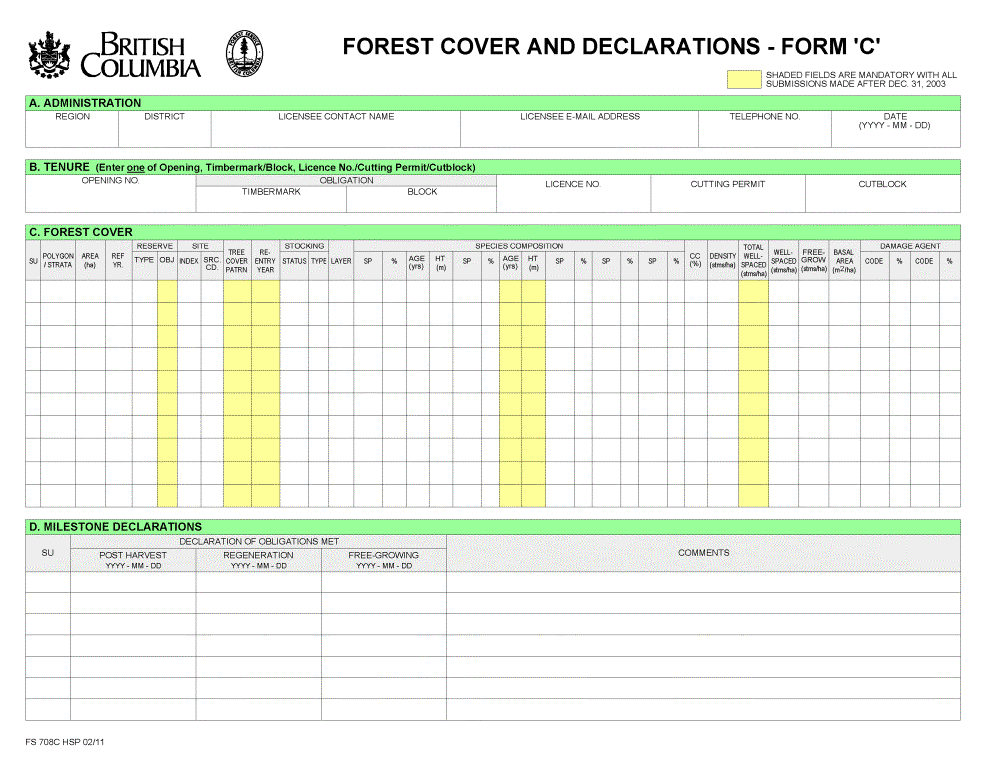
on the area, a report, on Form C, with a map containing the information
referred to in section 48 (1) (a) to (h). Format and timing of reporting 46 A holder
of an agreement under the Forest Act
who is required to establish a free growing stand on an area must submit to
the district manager, on or before May 31 each year, the following reports: (i) Form A identifying the standards that apply to the area contained
in a forest development plan, (ii) Forms B and C, and (iii) a map containing the information referred to in section
48 (1) (a) to (h); (c) for areas which have met the regeneration
date stocking requirements during the preceding year ending March 31, a
report in Form C with a map containing any changes in the information
referred to in section 48 (1) (a) to (h) from that which was submitted under
paragraph (a); (d) for areas which have met the free growing
stocking requirements during the preceding year ending March 31, a report in
Form C with a map containing any changes in the information referred to in
section 48 (1) (a) to (h) from that which was submitted under paragraph (c). Minister
may establish requirements 47 (1) The
minister, with respect to the reports referred to in section 45 or 46, may (a) require
Forms A, B and C and associated maps to be electronically submitted to the
ministry, (b) specify
the format of the electronic data submission, and (c) establish guidelines for silviculture
surveys and the content and accuracy of the information to be submitted on
maps, Forms A, B, and C or alternate approved forms. (2) Despite
section 45 or 46, if under subsection (1) the minister (a) requires
a form to be electronically submitted, or (b) specifies
the format and content of the submission, the holder of an
agreement under the Forest Act who
is required under this section to submit data or prepare a map must do so in
accordance with the requirements or specifications. 48 (1) A
map referred to in sections 45 (d) and 46 (a), (c) and (d) must be an
accurate map of the cutblock area and must describe (a) areas
occupied by permanent access structures, (b) areas
of rock, wetland or other area that in the area’s natural state is not
capable of supporting a stand of trees that meets the stocking requirements
referred to in section 18.1 of the Operational and Site Planning Regulation, (c) areas
of non-commercial forest cover that are indicated on an operational plan or
in the prescribed manner as not requiring the establishment of a free growing
stand, (d) areas
indicated on an operational plan or in the prescribed manner as a reserve
area not requiring the establishment of a free growing stand, (e) the
location of each standards unit within the cutblock and the standards
identification number linking each standards unit to the stocking
requirements contained in Form A, (f) Repealed.
[B.C. Reg. 292/2003, effective August 5, 2003] (g) the
mappable reserves within or contiguous to the cutblock, and (h) the
forest cover polygons within the cutblock. (2) Areas
referred to in subsection (1) (c) are areas of non-commercial cover indicated
in the prescribed manner for the purposes of paragraph (b) (iii) of the definition
of “net area to be reforested” in section 1 (1) of the Act. (3) Areas
referred to in subsection (1) (d) are reserve areas indicated in the
prescribed manner for the purposes of paragraph (b) (iv) of the definition of
“net area to be reforested” in section 1 (1) of the Act. Limitation of liability of persons to government 49 (1) For
the purposes of section 162.1 (3) of the Act, the prescribed period is 15
months. (2) When
considering a declaration from a holder of an agreement under the Forest Act submitted under section
162.1 (1) of the Act with respect to a regeneration date for an area under a
site plan, the district manager may accept the declaration, even if the
stocking requirements for the standards unit have not been met, if the
district manager determines that, during the one year period before the
regeneration date for the standards unit, the holder met the stocking
requirements for a minimum of 90% of the combined area of (a) the
standards unit, and (b) all
other standards units, for areas under site plans, for which the regeneration
date occurred during that year. (3) When
considering a declaration from a holder of an agreement under the Forest Act submitted under section
162.1 (1) of the Act with respect to a regeneration date for an area under a
site plan, the district manager may accept the declaration, even if the
number of well spaced trees of a preferred species per hectare for the
standards unit has not been met, if the district manager determines that, during
the one year period before the regeneration date for the standards unit, the
holder met the overall average of the prescribed minimum number of well
spaced trees of a preferred species per hectare on the combined area of (a) the
standards unit, and (b) all
other standards units, for areas under site plans, for which the regeneration
date occurred during that year. (4) A holder
of an agreement under the Forest Act
is exempt from the requirements of section 162.1 (5) of the Act. (5) A holder
of an agreement under the Forest Act
who makes a declaration under section 162.1 (1) of the Act in relation to an
obligation to establish a free growing stand on an area where a brushing
treatment has been carried out, remains responsible for the obligation unless,
at the time of the declaration, (a) the
crop trees on the area meet the height relative to competing vegetation
requirement for the area (i) specified in a silviculture prescription, or (ii) if there is no silviculture prescription, specified in a forest
development plan, and (b) subject
to subsection (6), the period since the brushing treatment was carried out is (i) a minimum of (A) 2 years for a chemical brushing treatment, and (B) 3 years for a manual brushing treatment in the Sub-Boreal
Spruce biogeoclimatic subzone or the Black and White Boreal Spruce
biogeoclimatic subzone, or (ii) a minimum of 2 years for any brushing treatment for areas other
than those referred to in subparagraph (i). (6) The
district manager may authorize a shorter period than specified in subsection
(5) (b). (7) For the
purposes of section 162.1 (6) of the Act, the stand must conform with the
following: (a) for
areas under a silviculture prescription, the area must be within the “free
growing assessment period” as defined in section 70 (1) of the Act; (b) for
areas under a site plan, the earliest free growing assessment date specified
in the forest development plan has passed. Waiver or funding of free growing obligation 50 (1) To
claim the relief or funding under section 162.2 of the Act relating to the
establishment of a free growing stand, a person must provide to the district
manager the following information: (a) the
nature of the relief sought and why the person is entitled to it; (b) if
the relief sought is funding under section 162.2 (4) of the Act, a proposal
for the course of action and time frame for returning the stand to the
condition referred to in that subsection, and an estimate of the extra
expense involved in carrying out the course of action. (2) If the
district manager is satisfied that the relief of an obligation or funding is
required, then within 1 year of receiving all the information referred to in
subsection (1), the district manager must grant the relief or provide the
funds. (3) If the
district manager determines that (a) the
obligation to establish a free growing stand should continue, and (b) either (i) the person has not provided a proposed course of action, or (ii) the proposed course of action is unacceptable, then the district
manager must provide and fund an alternate course of action. (4) For the
purposes of section 22.1 (1) of the Act, a silviculture prescription for an
area is without effect if, under section 162.2 (3) (b) of the Act, the
district manager has relieved the holder of the prescription from the
obligation to establish a free growing stand on the area. 51 (1) A holder of an agreement under the Forest Act who contravenes section 9, 10, 11 or 43 (2) commits an offence. (2) A person who commits an offence is liable,
on conviction, to a fine not exceeding $5 000 or to imprisonment for not more
than 6 months or to both. Limitation
on application of irreparable damage 52 A
holder of an agreement under the Forest
Act does not commit an offence under section 145 (2) of the Act if the
holder is (a) operating
under (i) a site plan required under section 21.1 of the Act, or (ii) an exemption from the requirement to have a site plan, and (b) acting
in accordance with Part 3 of this regulation. 53 (1) For
the purposes of section 45 (3) (b) of the Act, “inordinate soil disturbance” means soil disturbance that (a) results in the district manager requiring
rehabilitation of soil under section 48 (1) of the Act, or (b) exceeds the soil disturbance limit specified
in section 31 of this regulation. (2) For the
purposes of section 45 (3) (c) of the Act, “significant damage” means any damage to a lake, stream or other
watercourse that results from the deposit of a petroleum product or a fluid
used to service logging equipment. Authorization
to cut trees for survey or fire control 54 For
the purposes of section 96 (1) (e) and (f) and (2) of the Act, a
person is authorized to cut, remove, damage or destroy Crown timber in the
course of (a) carrying
out duties as a land surveyor, or (b) fire
control or suppression operations. Free
miner's incidental harvesting 55 (1) Pursuant
to section 96 (1) (c) of the Act, Crown timber may be cut, damaged
or destroyed by hand held tools for the purpose of mineral exploration by a
free miner under the Mineral Tenure Act before the free miner requires
a permit under section 10 of the Mines Act. (2) Except
for minor clearing of brush and downed trees, subsection (1) does not
permit cutting, damaging or destroying Crown timber beyond the minimum
necessary for the safety of persons carrying out the activities. Authorization
to cut trees related to silviculture, stand tending or forest health 56 For
the purposes of section 96 (1) (f.1) of the Act, a person is
authorized to cut, damage or destroy Crown timber on an area if the cutting,
damaging or destruction of the timber is carried out by (a) a
holder of an agreement under the Forest Act in the course of carrying
out silviculture treatments, stand tending treatments, forest health
treatments, or any other activity that is ancillary to the purposes of the Forest
Practices Code of British Columbia Act, or (b) a
person in the course of carrying out silviculture treatments, stand tending
treatments, forest health treatments, or any other activity that is ancillary
to the purposes of the Forest Practices Code of British Columbia Act,
and the treatment or activity is (i) authorized by the district manager, or (ii) funded under the Forest Investment Vote in the estimates of the
ministry. Enactments
referred to in section 96 of the Act 57 This
regulation is a prescribed enactment for the purposes of
section 96 (1) (g) (iii) of the Act. Notice
required for timber harvesting 58 (a) the
location of the cutblock, (b) the
holder of the agreement under the Forest Act, (c) the
name of the holder's representative who is responsible for conducting the
timber harvesting, and (d) the
projected date for commencement.
|
|||||||||||||||||||