Generic Forest Health Surveys Guidebook
Introduction
This guidebook is intended to assist field practitioners in determining forest health issues and the incidence of forest health factors in high-hazard forest ecosystems. These are forest ecosystems that are constantly being adversely affected by forest health factors. Consult the Glossary for the meaning of specialized words or phrases and Appendix 1 for a list of acronyms used in this guidebook.
The Operational Planning Regulation (OPR) requires an evaluation of forest health issues relevant to the area under the forest development plan (FDP). Where there are significant risks to resource values identified in the plan, appropriate management strategies to deal with those effects must be undertaken during the term of the plan. Additionally, subject to district manager requirement, a forest health assessment to determine the nature and extent of forest health factors must be completed for the area under the plan.
FDP forest health assessments (typically hazard or risk surveys requested by the district manager) will be undertaken for areas where the licensee expects to be operating over the period of the plan. Usually, the district manager will require surveys if significant pest problems affect the implementation of the plan within a reasonable time period.
The process in the FDP of conducting a forest health assessment for possible treatment action is described in Figure 1. Landscape-level surveys and their relationship with operational and stand-level forest health surveys are shown in Figure 2. A complete list of all landscape- and stand-level forest health surveys is described in Table 1.
The district manager may also request a pest incidence survey of forest health factors in a cutblock or silvicultural opening described in the FDP. Typically, this involves an assessment of specific factors. Survey procedures related to specific factors are included in the guidebooks, describing bark beetles, defoliators, dwarf mistletoes, pine stem rusts, root diseases, terminal weevils, and tree wounding and decays. The district manager may set the scope and attributes of each requested survey.
In addition, some regions have standard operating procedures for specific forest health factor surveys unique to those regions provide more detail than is included in this guidebook.
Figure 1. Process of pest hazard or risk rating related to Forest Development Planning.
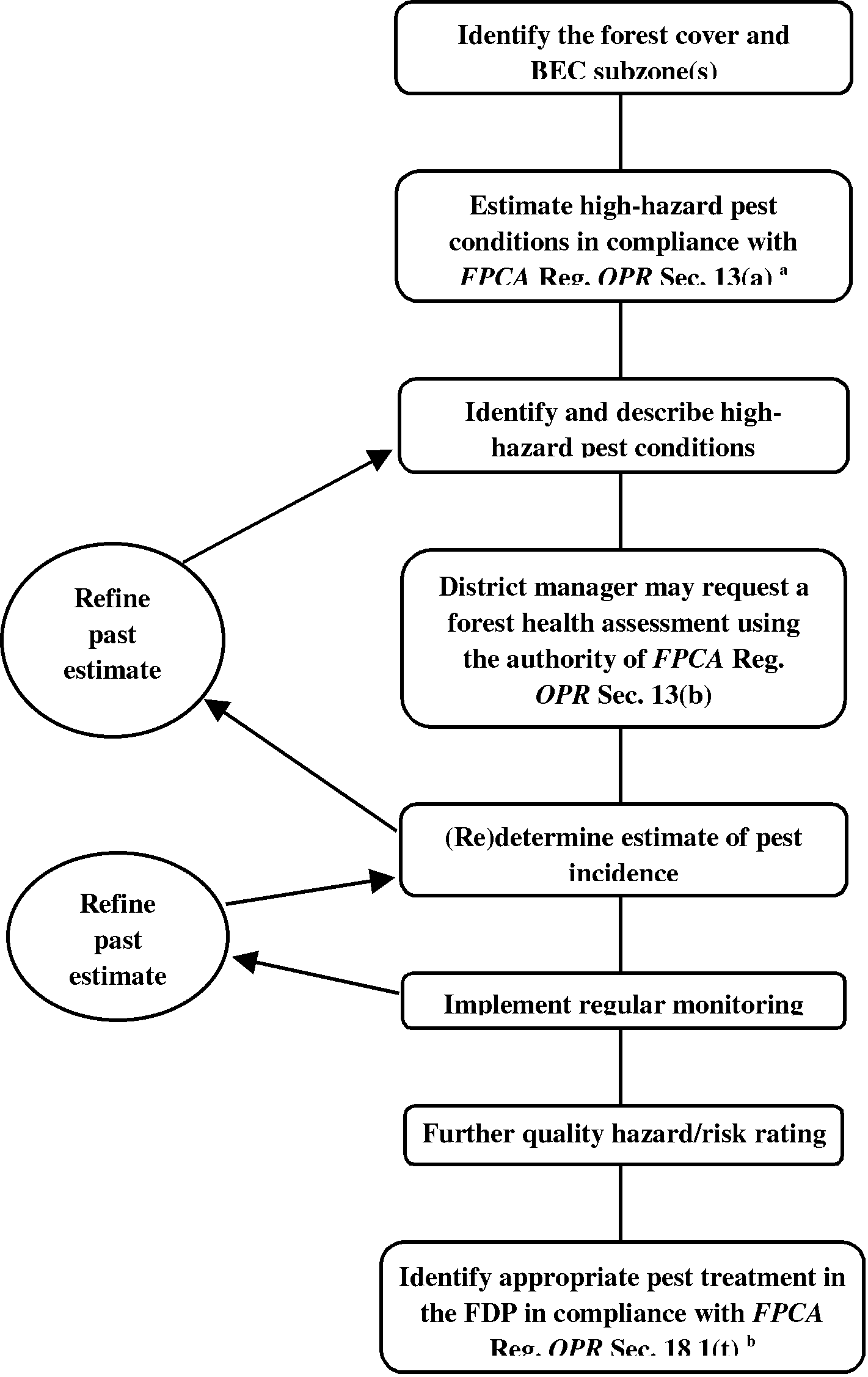
a See regional forest health charts listed at the end of the introduction
section
b See relevant forest health guidebooks
Figure 2. Landscape-level forest health surveys and their relationship with operational and stand-level surveys.
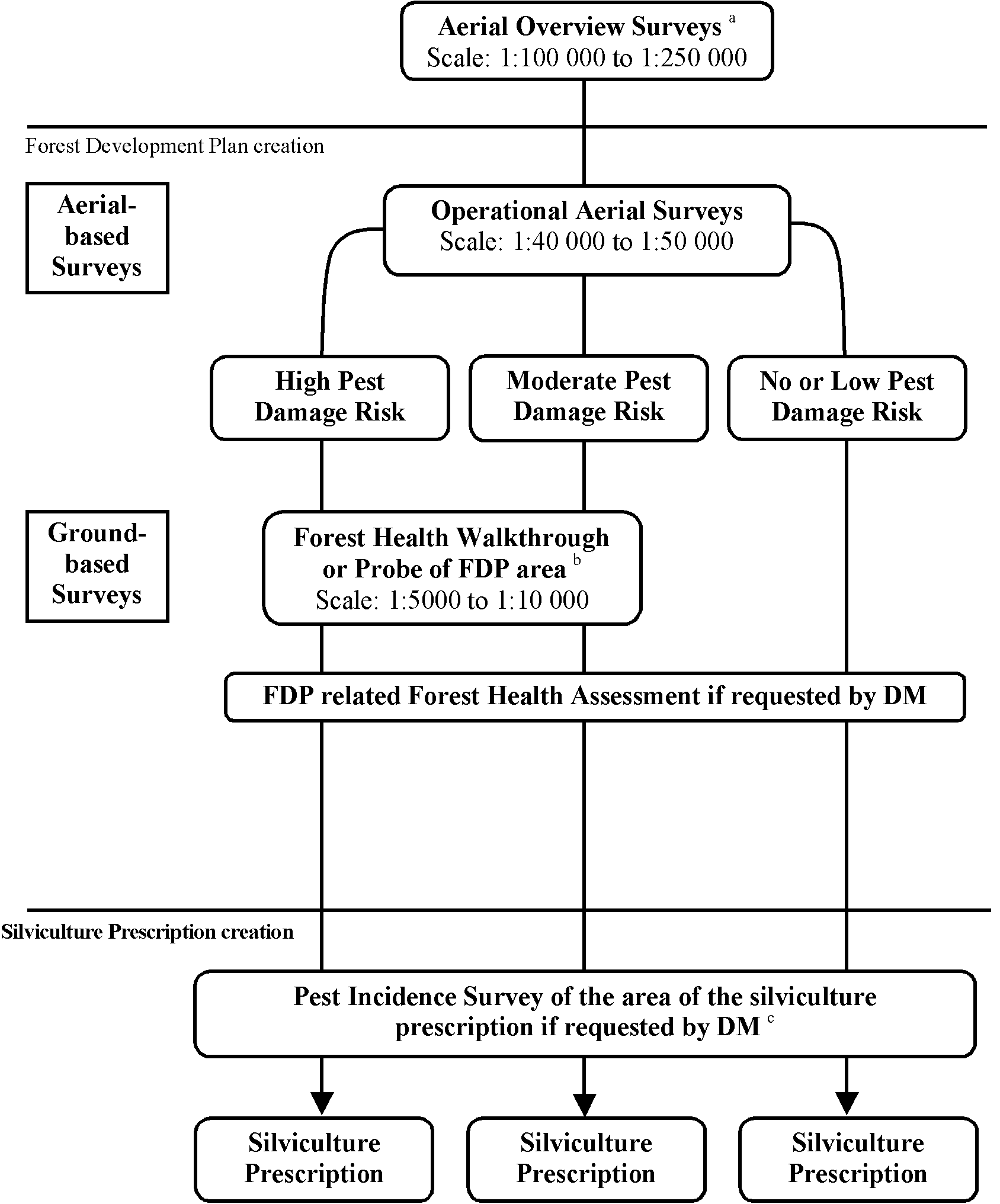
a Conducted by the BCMOF.
b Assumed that no ground-based surveys or walkthroughs are considered necessary
at the landscape level for low damage risk situation. A determination that an
area is at low risk could be made from a review of forest charts for the area
and with assistance from the aerial overview survey.
c Expected that pest incidence surveys are particularly useful for moderate
pest damage risk areas. Treatments associated with high pest damage areas are
expected, and treatments associated with low pest damage risk areas are
expected to be uncommon.
Table 1. Summary of forest health surveys for Forest Practices Code plans and prescription-level surveys
|
Survey |
Reference |
|
|
I.
Forest Health Inventory |
||
|
Aerial
Overview Surveys (>1:100,000 )a |
Forest
Health Surveys Guidebook |
established |
|
Survey
for Pest Incidenceb |
Forest
Health Surveys Guidebook |
new |
|
II.
Operational Surveys
|
||
|
A.
Landscape-levelc Surveys |
||
|
Operational
Aerial Surveys (1:50,000) |
Forest
Health Surveys Guidebook |
established |
|
Forest
Health Walkthrough |
Forest
Practices Branch |
availabled |
|
Bark
Beetle Damage Probes |
Bark
Beetle Management Guidebook |
established |
|
Defoliator
Damage Prediction |
Defoliator
Management Guidebook |
|
|
–
Douglas-fir tussock moth |
established |
|
|
–
eastern spruce budworm |
established |
|
|
–
western black-headed budworm |
established |
|
|
–
western hemlock looper |
established |
|
|
–
western spruce budworm |
established |
|
|
Adult
monitoring for: |
Defoliator
Management Guidebook |
|
|
–
Douglas-fir tussock moth |
established |
|
|
–
western hemlock looper |
established |
|
|
2nd
instar larval sampling for |
Defoliator
Management Guidebook |
|
|
–
eastern spruce budworm |
established |
|
|
–
western spruce budworm |
established |
|
|
B.
Stand-level Surveyse |
||
|
1.
Generic stand-level surveys: |
||
|
Multipest
survey |
Forest
Practices Branch |
availabled |
|
Silviculture
surveys |
Silviculture
Surveys Guidebook |
|
|
–
circular (3.99m) plots |
established |
a Conducted by the BCMOF.
b Background information for licensees and BCMOF.
c Related to FDP creation.
d Related to silviculture and stand management prescriptions.
e This survey is available from the Forest Practices Branch. It has
been previously developed and has been rarely used in past years.
|
Survey |
Reference |
Status |
|
B.
Stand-level Surveys
|
||
|
2.
Specific stand-level surveys |
||
|
Root
disease surveys |
Root
Disease Management Guidebook |
|
|
–
Pre-harvest walkthrough |
established |
|
|
–
100% sketch map |
established |
|
|
–
Pre–stand tending transect |
established |
|
|
–
Post-harvest stump-top (for tomentosus) |
established |
|
|
–
Pre-harvest transect (intersection length method) |
established |
|
|
Dwarf
mistletoe surveys |
Dwarf
Mistletoe Management Guidebook |
|
|
–
Hawksworth rating system |
established |
|
|
Stem
rust surveys |
Stem
Rust Management Guidebook |
|
|
–
Pre–stand tending rust assessment |
established |
|
|
Wound
and decay surveys |
Tree
Wound and Decay Guidebook |
|
|
–
Post-harvest tree damage assessment |
established |
fRelated to silviculture and stand management prescriptions.
To identify potentially high-hazard forest ecosystems, refer to the regional forest health charts or contact regional forest health staff. Stand susceptibility maps relevant to the forest health factors available in some regions should also be consulted. These information sources must be considered together because there is no single reference listing forest health hazard levels for all forest ecosystems. Forest health charts available from regions are as follows:
- Lloyd, D. 1990. A guide to site identification and
interpretation for the Kamloops Forest Region, conifer pests in the
Kamloops Forest Region. Land Management Handbook No. 23, BCMOF, pp.
287–290.
- Braumandl, T.F. and M.P. Curran. 1992. A field guide
for site identification and interpretation for the Nelson Forest Region.
Land Management Handbook No. 26, BCMOF, Sec. 7, pp. 214–226.
- Banner, A. 1993. A field guide to site identification
and interpretation for the Prince Rupert Forest Region. Land Management
Handbook No. 26, BCMOF, Sec. 7, pp. 74–80.
- Green, R.N. and K. Klinka. 1994. A field guide for site
identification and interpretation for the Vancouver Forest Region. Land
Management Handbook No. 28, BCMOF, pp. 221–229.
Forest health charts are not published for the Cariboo and Prince George forest regions, although the information may be available from regional staff.
Where there are no high-hazard forest ecosystems within the FDP area, a summary note in the FDP should satisfy the OPR incidence reporting requirement.
When a high-hazard area is found, specific surveys should be conducted to quantify the incidence and hazard of the relevant forest health factors. An operational aerial survey of the FDP area is recommended. Additional surveys that may be prescribed are listed in Table 1.
As more information becomes available, the FDP may be updated through amendment, and treatments to minimize pest risk included in future site-specific prescriptions.
Recommended procedures encompassing forest health, and associated with the completion of a silviculture prescription, are found in the Guidelines for Preparation of Silviculture Prescriptions. Details concerning specific forest health surveys will be found either in this guidebook or in other forest health guidebooks devoted to specific damage agents. Silviculture surveys are used to measure the achievement of healthy free growing stands; the survey procedures are outlined in the Silviculture Surveys Guidebook.


