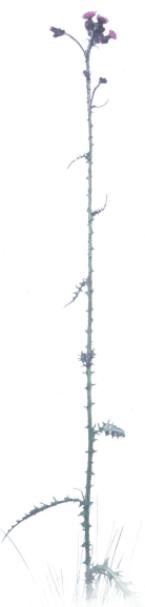
Marsh Plume Thistle:
Knapweed of the North?
By Linda Kolisnek, Communications Co-op Student, Prince
GeorgeThere are aliens among us and they’re reproducing at an alarming
rate.
The exotic weed Cirsium palustre, better known as marsh plume thistle, is rapidly
invading B.C.’s north between McBride and Prince George. With no known natural
enemies to control it, marsh plume thistle threatens to occupy sites that would otherwise
support a diversity of native plant species.
The consequences can be serious: These weeds degrade animal habitat and forage, reduce
biodiversity, choke out riparian areas and impede the growth of desired plants.
Marsh plume thistle was first documented in Prince Rupert in 1954. It was likely
introduced to the McBride area within the last 15 years.
"It can flourish in a variety of sites. We have even found it growing under forest
canopy," said UNBC co-op student Kristin Maitland, working for the Prince George
forest region.
This thistle is conspicuous once it reaches the stem- and flower-bearing reproductive
phase. It grows to about 1.5 meters, with a distinctively unbranched, narrow stem. In the
fall, each flower produces numerous, wind-dispersed seeds, which can persist in the seed
bank for several years
Destroying the weed remains a puzzle. "We can’t use chemicals in riparian
areas," said Perry Grilz, Range Planner with the Prince George forest region.
"We are trying to devise a containment program that will stop it from spreading
beyond its current range."
If you discover this plant growing beyond its known range, please call Perry at (250)
565-6774.
Editor’s Note: The Marsh Plume Thistle is classed currently in B.C. as a
nuisance, rather than noxious, weed. The ministry is part of an international program
working to cut populations of unwanted weeds to levels that are ecologically and
economically acceptable. The program’s tools include prevention, herbicide spraying,
hand-pulling, seeding, clipping and biological control—the use of parasites,
predators and pathogens to attack unwanted species.

The marsh plume thistle is just one of the many problematic
weeds that grow in B.C.
This Ministry of Agriculture Web site lists B.C.’s
noxious weeds and provides photos of each: http://www.agf.gov.bc.ca/croplive/cropprot/weedguid/weedguid.htm
The Ministry of Forests offers a list of insects that
attack problem weeds at: http://www.for.gov.bc.ca/hfp/pubs/interest/bioagent/bioagent.htm
The two ministries together published a handy, pocket-sized
Field Guide to Noxious and Other Selected Weeds, updated this year and available through
forest district and regional offices. If the local supply is low, offices can order more
from the Forest Practices Branch in Victoria.
Anyone
in the province can join the battle against these invaders: |
|
• |
Learn to identify them. |
|
• |
Act immediately to prevent them from
spreading seed. |
|
• |
If they have flowered, cut them and put them
in leak-proof bags. |
|
• |
Clean your equipment, vehicles and footwear
thoroughly before leaving an infested area. |
|
• |
Don’t move infested soil. |
|