| Adding Value As sap
began to flow in Haida Gwaii’s red cedars, twenty-five members of the Queen Charlotte
MOF district office joined Haida weavers on a trek to strip bark that would be used to
create a range of cedar products, jobs and some cross-cultural understanding.
Xaad Kil, Old Massett’s language program, was contracted to provide a
cross-cultural experience to office staff.
Elizabeth Moore and April Churchill made the arrangements for the trip to a cutblock
North east of Juskatla.
Here, the trees are natural regrowth following a fire about 100 years ago. They range
from 20 to 40 centimetre around and are the ideal size from which to take strips of bark
while still leaving the trees healthy to grow.
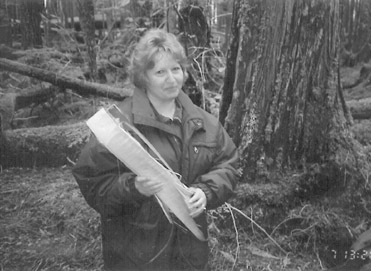
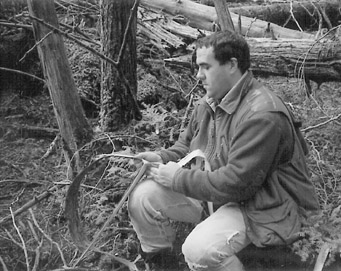
The day for gathering was mercifully dry but cold. After a short introduction on the
significance of cedar and some of its more than 40 cultural applications, seven weavers
led the visitors, in small groups of five or six, to take the first bark of the year in
the traditional manner.
The tradition is to walk the forest until a tree communicates its willingness to give
its bark. Each weaver gave a prayer song, teaching enough so that forestry staff could
sing or mumble along.
Then the gatherers cut into the bark a few inches from the forest floor, an incision
less than a fifth of the circumference of the tree on a face with a long stretch of
straight grain, free of branches.
Prying a hand’s breadth-width from the base, pieces up to forty feet will come
clear, if the tree is willing. The outer dead bark is stripped clear and respectfully
placed at the base of the tree. The inner living bark—phloem—is then coiled and
bundled for carrying home.
More than sixty people worked peacefully together, spread about in mossy niches. They
were joined by more weavers, naanis, chinis, and great-grandchildren from Skidegate and
Old Massett, and students from the George M. Dawson High School.
There was concentration and there was laughter. The Rev. Lily Bell, minister of St.
John’s Anglican Church in Old Massett, offered a prayer and song of gratitude, in
praise of the trees that provide so much.
Some weavers could not bring themselves to take more than a few inches of bark even
though they knew the trees would soon be felled. It is aberrant to strip a tree
completely.
MoF staff did not see the hours of preparation of the inner bark into the two or three
thin layers used for weaving. It is painstaking, fun, family work that would go far into
the small hours of the next morning.
A traditional strip from a tree of about 1.5 cubic metres will produce perhaps $1,500
worth of plaited hats and baskets, and the tree will continue to grow. That tree might
produce about 460 board feet of dimensional lumber worth $270.00 on the current market. As
a top quality, 50-foot telephone pole it would sell for $715. Using all the bark from such
a tree, Haida weavers could potentially turn it into over $7,000 worth of goods. Using the
two- or three-string twine method to create art pieces, that value could be doubled.
The bark the weavers and MOF staff gathered has been distributed to the Haida
language-and cultural studies-programmes in the local schools. Some will be used to make
mats in which to wrap the remains of ancestors, when they are repatriated at last from
international museums that had caused their removal from gravesites. Negotiations continue
with museums unwilling to allow all remains to be brought home to rest. Slowly, the forest
heals.
• contributed by several participants
 www.for.gov.bc.ca/vancouvr/district/queen/qcinfo.htm

Did You Know?
The B.C. forest sector employed an average 85,600 people in
1999 — 3,300 more than in 1998.
A typical B.C. logging truck carries 30 cubic metres of
timber.
A telephone pole contains about one cubic metre of wood. |