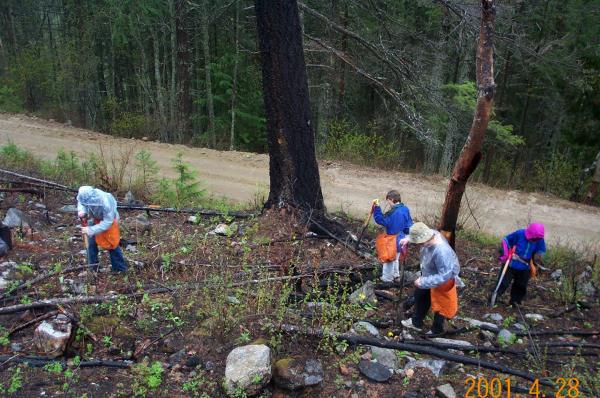
Nelson District Scouts plant Ponderosa Pines
By Kate SmithsonApril showers brought
out scouts with shovels and pine seedlings on Kokanee Glacier road this year. Beavers,
cubs and scouts from Nelson, Salmo, Bonnington, Nelson, Willow Point and Kaslo helped make
the world a greener place by planting hundreds of Ponderosa Pine trees.
It’s part of a 29-year national tradition. Locally, about 70 scouts participated
in the of the Scoutrees Canada program. Every spring, 80,000 scouts across the country
plant an average of about 25 trees. Since the program started in 1972, Canada’s
scouts have planted about 70 million trees.
"We want the kids to get out, get their hands dirty, plant a tree, and get a
feeling for the environment they live in," said John Reitveld of Scouts Canada,
speaking from Ottawa.
"We encourage them to go back to the site several times over the next year to make
sure the trees are doing well."
Reitveld says scouts in B.C. are strong participants in the program, particularly in
the rural areas.
The organization’s Web site says there are two very specific goals to the program.
"Scoutrees for Canada is a national environmental program that involves youth in a
meaningful and hands-on conservation project. Trees help prevent soil erosion, provide
much needed oxygen for wildlife and humans to breathe, and add beauty and shade to our
parks. We plant trees first and raise money second."
Scouts Canada plans to evaluate the program over the next year. Scouts in urban areas
are having difficulty finding locations to plant trees, and sometimes the trees they plant
are accidentally "mowed" by city staff who don’t realize a new forest has
been planted.
"It’s happened three years in a row in Ottawa," said Reitveld.
"It’s frustrating."
One solution is to plant fewer, bigger trees, in higher visibility areas in urban
centres.
"It would be a move from the environmental to the aesthetic quality,"
Reitveld said. "It could mean a change in the way urban scouts participate in this
program."
Finding locations for planting and ensuring the survival of trees planted are not
issues in rural B.C. The trees planted by scouts in the Nelson area this year helped
replant a recently logged opening cutblock in the forest.
 www.scouts.ca/index.stm
|